
WHY WORDS?
More than sounds.
For most of us, words are simply a way to communicate.
We ask questions.
Tell stories.
Write shopping lists.
But for thousands of years, people believed words could do much more.
A blessing could encourage.
A promise could bind.
A prayer could comfort.
Across many cultures, spoken words were treated as something that could influence life itself—not because of magic, but because people believed words carried intention as well as meaning. Saying something aloud often mattered just as much as doing it.
A NAME WAS NEVER JUST A NAME
One of the oldest examples is the way people treated names.
In many ancient cultures, a person's true name was considered something deeply personal. Names could express hope, identity, family history, or divine protection. In medieval Europe, children were often named after saints, believing the name connected the child with that saint's protection. Ukrainian naming traditions also preserved the idea that a name carries spiritual meaning beyond simple identification.
Words Could Be Spoken...
Traditional Ukrainian culture preserved many examples of this belief.
Parents blessed their children before an important journey.
Newlyweds received spoken blessings before marriage.
Farmers pronounced words over fields before sowing.
Healers combined herbs with spoken formulas.
These customs were different in purpose, but they shared one idea:
Words were believed to participate in reality, not simply describe it.
...and They Could Be Worn
Later, words began appearing in objects themselves.
Initials were embroidered onto handkerchiefs.
Family monograms decorated linens.
Names were carved into wood, engraved into rings, written inside books.
Sometimes they marked ownership.
Sometimes memory.
Sometimes love.
Sometimes protection.
The object carried something personal because the word behind it mattered.
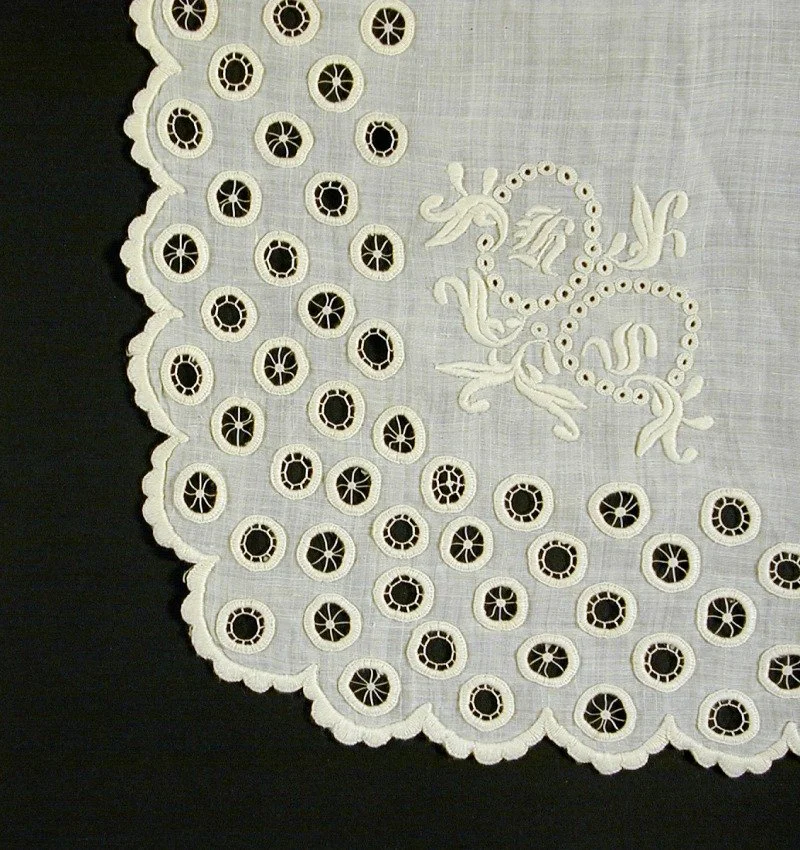
Handkerchief with embroidered initials, 19th century
Germany or Switzerland. Collection of the Los Angeles County Museum of Art (Public Domain).
FROM WORD TO ORNAMENT
Encoded Intention begins from the same starting point.
Not because words are magical.
But because words have always helped people give shape to invisible things.
Hope.
Love.
Strength.
Protection.
Instead of writing the word onto the object, this method transforms its letters into geometry.
The word disappears.
Its structure remains.
DID YOU KNOW?
For thousands of years, words were believed to have power.
Many cultures believed that spoken words could bless, protect, heal, or curse. Words were often treated as actions, not just sounds.
Names were chosen with great care.
Across many cultures, a child's name was believed to express hope, protection, family memory, or the qualities parents wished for the future.
In traditional Ukrainian culture, blessings were spoken before important moments.
Parents blessed their children before long journeys, marriage, military service, or starting a new home. Spoken words were believed to carry real meaning into life.
Writing was once considered something sacred.
For centuries, the ability to read and write belonged to only a small part of society. Written words often carried a sense of authority, memory, and permanence.
Many old embroidery traditions combined words, symbols, and ritual.
Across Europe and beyond, textiles often carried blessings, prayers, initials, dates, or symbolic motifs intended to protect the person who wore or received them.
CONTINUE EXPLORING
Why are these ornaments built from Ukrainian letters?
→ Read: Why Ukrainian?
Or explore the complete design process in Stitched IN — The Complete Design Method.